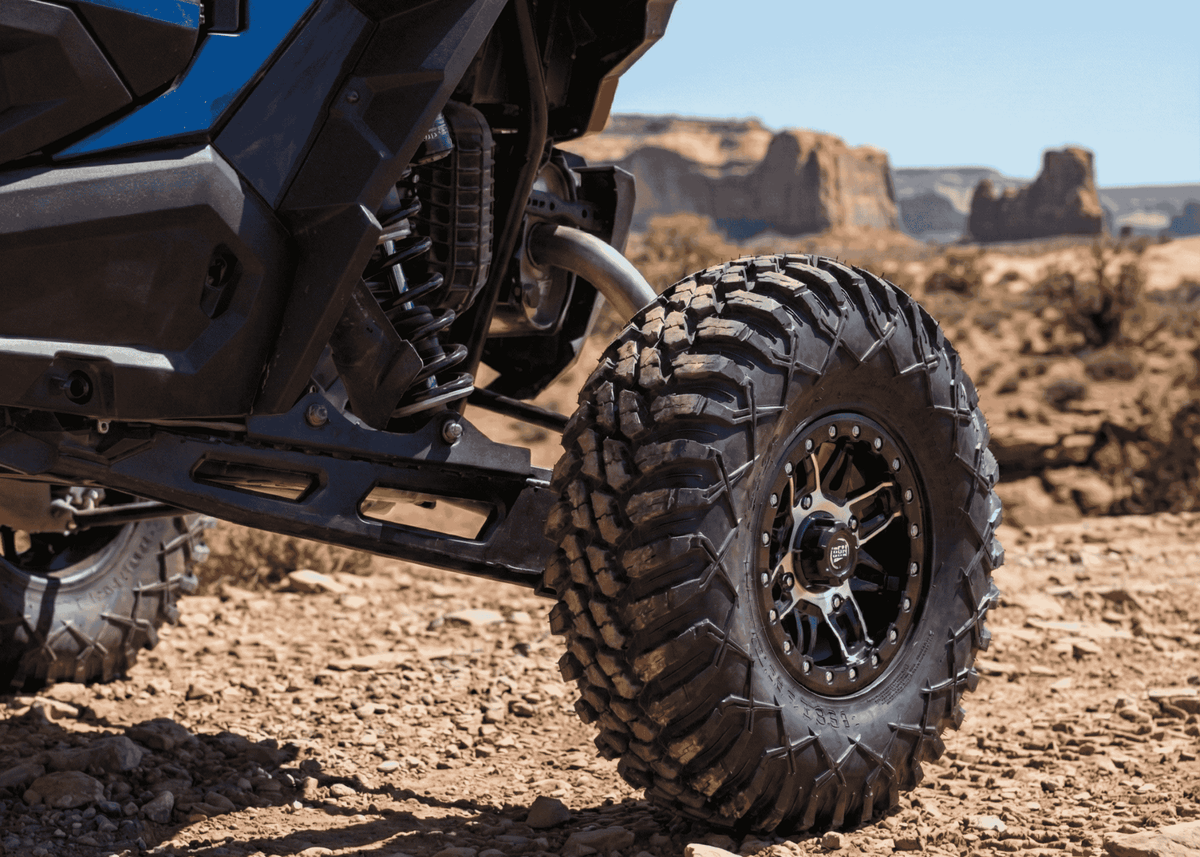

Choosing the right UTV tires is, without a doubt, the most agonizing financial decision you will make after buying the machine itself.
You are staring at a screen filled with black rubber circles that all look vaguely angry. Some have scoops, some have spikes, and some look like they belong on a tractor. They range from $150 to $500 per corner. And if you get it wrong?
You aren't just out two thousand bucks; you’re the guy getting winched out of the first mud puddle while your buddies laugh at you. Or worse, you’re the guy with a blown belt and a snapped axle five miles from the trailhead because you bought tires your machine couldn't turn.
With UTVs becoming more powerful—pushing 200+ horsepower in stock trim—tire technology has had to sprint to catch up. The "knobby balloons" of the ATV tires of yesterday are gone. Modern side by side tires are engineering marvels, capable of surviving trophy truck speeds in the desert or gripping vertical granite walls like a gecko.
But here is the truth the marketing brochures won't tell you: There is no such thing as a perfect tire.
A tire that grips like glue on rocks will wear out in a week on hard packed surfaces. A tire that floats over sand dunes will shake your fillings loose on gravel. The best UTV tires are the ones that perfectly match your specific riding style, your local terrain, and your budget.
This is your Bible for 2026. We aren't just listing tires; we are breaking down the physics of grip, the "hidden ecosystem" of upgrades you need for big rubber, and detailed Rider Archetypes so you can find exactly who you are and what you need.
Quick Picks: Best UTV Tires for 2026
If you are standing in the garage ready to buy and don't want the science lesson, here is the cheat sheet. Click the tire name to jump to the full review.
| Category | Winner | Best For | Approx. Price |
| Best Overall Trail Tire | Maxxis Carnivore | 90% of riders. Fast trails, light mud, rocks. | $$ |
| Best Budget Trail Tire | Tusk Terrabite | Hardpack, fire roads, street use. | $ |
| Best Premium Trail Tire | BFGoodrich KM3 | Desert speed, sharp rocks, durability. | $$$ |
| Best Mud Tire | SuperATV Assassinator | Deep mud, bounty holes, swamps. | $$ |
| Best Rock Crawler | Maxxis Roxxzilla (Sticky) | Technical crawling, Moab, Sand Hollow. | $$$ |
| Best Dune Tire | CST Sandblast | Sand dunes (Glamis, Silver Lake). | $$ |
| Best Desert Racer | Tensor DS | High-speed desert racing, hardpack. | $$$ |
| Best Overlanding Tire | Kanati Mongrel | Long-distance expedition, heavy loads. | $$ |
| Best Utility/Farm Tire | Kenda Bearclaw HTR | Work, snow, mixed farm use. | $ |
How to Choose the Best UTV Tires (The 80/20 Basics)
Before we dive into the specific reviews, you need to understand the architecture of a tire. Selecting the right rubber comes down to three structural factors: Construction, Ply Rating, and Compound. Getting these wrong is why people hate their tires.
1. Radial vs. Bias Ply: The Ride Quality War
This is the single most important distinction in radial vs bias-ply construction. It dictates how the tire moves, flexes, and absorbs energy.
Bias Ply Tires: The old school tough guys. The internal nylon cords run diagonally (crisscross) from bead to bead at a 30-45 degree angle.
- The Feel: Stiff. Because the plies run continuously from bead to bead, the sidewall and the tread face are mechanically linked. If the sidewall flexes, the tread squirm.
- The Pros: Incredibly tough sidewalls that resist punctures. They are cheaper to manufacture and naturally "self-clean" in mud because the carcass twists and flexes, ejecting clay.
- The Cons: They develop "flat spots" when parked overnight, leading to a bumpy ride for the first few miles. They wander and "hunt" at high speeds.
Radial Tires: The modern performance standard. The internal cords run straight across (90 degrees) from bead to bead, with separate stabilizer belts under the tread.
- The Feel: Plush and precise. The sidewall can flex independently of the tread, acting like a secondary suspension system.
- The Pros: Comfort is the main selling point. They offer superior high-speed stability, steering precision, and a flatter contact patch on hard surfaces.
The Verdict: Unless you are building a dedicated mud bogger or a slow-speed farm crawler, buy radials. The difference in ride quality on a modern, fast UTV is night and day.
2. Ply Rating (The Durability Myth)
In the old days, "8-ply" meant there were literally 8 layers of cotton fabric. Today, materials like Kevlar and Nylon are so strong that we don't need that many layers. The ply rating is now just a metric used when comparing 8-ply vs 10-ply toughness.
- 4-Ply: Common on cheap, entry-level ATVs. Paper thin. Avoid these if you value your time; a sharp stick will go right through them.
- 6-Ply: The minimum standard for a stock UTV. Decent for lightweight design, but prone to pinch flats in rocky terrain. If you run 6-ply tires in the rocks, carrying a trail-rated tire repair kit isn't optional—it's mandatory.
- 8-Ply: The Goldilocks zone. Tough enough for desert racing, light enough not to kill your axles. This is the standard for premium tires like the Maxxis Carnivore or BFG KM3.
- 10-Ply: The Tank. Used for heavy rock crawling or extreme desert durability. The trade-off is weight. Heavier tires rob horsepower and snap axles. Only go 10-ply if you ride in "tire killing" terrain like sharp shale or volcanic rock.
3. Rubber Compounds: Hard vs. Sticky
This is the secret sauce. Two tires can look identical but perform completely differently based on their chemical makeup.
- Hard Compound: Designed for road, gravel, and hard packed surfaces. It resists abrasion and lasts for thousands of miles. However, on wet rocks or cold pavement, it can feel like driving on hard plastic—slippery and vague.
- Soft (Sticky) Compound: Used in tires like the Maxxis Roxxzilla or JConcepts Ruptures. It contains softer polymers that grip like Spiderman, molding themselves to the microscopic texture of the rock. The trade-off is longevity. If you drive a sticky tire on hot asphalt, you can literally see the rubber erasing. You are trading money for excellent traction.
Key Takeaways - Choosing Your Tire
- Radials are for trail/desert/road comfort. Bias Ply is for mud/farm durability.
- 8-Ply is the standard for modern UTVs. 10-Ply is heavy-duty but robs power.
- Sticky compounds win races but lose money on pavement.
UTV Tire Anatomy 201: Void Ratios, Siping, and Side Biters
Why do some tires hum while others roar? It comes down to the void ratio and siping.
-
Void Ratio: This is the amount of empty space (void) versus rubber lug on the tire.
- Low Void (Truck Style): Lots of rubber, small gaps. Great for hard pack, rocks, and street. Quiet and smooth.
- High Void (Mud Style): Massive gaps between lugs. Essential for cleaning out thick clay, but terrible for smooth rides. The large gaps cause the tire to "slap" the pavement, creating vibration.
-
Siping: These are the tiny, razor-thin slits cut into the tread blocks (common on the Kenda Bearclaw HTR).
- Function: Sipes allow the tread block to flex and open up, creating thousands of tiny biting edges. This is critical for snow, ice, and wet rocks. A solid lug slides on ice; a siped lug bites.
- Side Biters: Look at the sidewall. Does the tread wrap down the side? These "side biters" are crucial for ruts. When your UTV sinks into a rut, the face of the tire isn't touching anything. The side biters grab the walls of the rut to pull you forward.
Best UTV Tires by Riding Style (7 Rider Archetypes)
Stop looking at tires generically. Look at how you ride. We have categorized these based on performance, tread depth, and the specific needs of different terrains.
Archetype 1: The Weekend Warrior – Best UTV Trail / All-Terrain Tires
Who You Are: You ride a mix of everything. Fire roads, forest trails, a little bit of mud, some rocky climbs, and maybe a paved road to get to the gas station. You value longevity and don't want to change tires every season.
The Top Pick: Maxxis Carnivore

| Type | Radial, 8-Ply |
| Best For | Fast trails, light rocks, mixed terrain. |
| Sizes | 28–32 in (Common: 30x10R14, 32x10R15) |
| DOT | No |
| Weight | ~35–38 lbs (light for an 8-ply) |
Why It Wins: The Carnivore changed the game. It balances weight and toughness perfectly. The lug spacing is wide enough to clean out trail mud, but the lugs are grouped tightly in the center to roll smoothly on hardpack. It handles high speed beautifully and offers a comfortable ride.
Who Should Avoid It: Deep mud riders (it packs up) and pavement cruisers (it wears faster than a truck tire).
The Budget Champion: Tusk Terrabite
| Type | Radial, 8-Ply |
| Best For | Hardpack, gravel, street use. |
| Sizes | 27–32 in |
| DOT | Yes (compliant) |
| Weight | ~34–40 lbs |
Why It Wins: The king of value. It uses a truck-style tread pattern that wears like iron on hardpack and rocks. It is DOT-compliant and incredibly smooth.
The Catch: It is terrible in deep mud; the tight tread packs up and turns into a racing slick instantly. If you ride sticky clay, skip this.
The Premium Choice: BFGoodrich Mud-Terrain T/A KM3 UTV

| Type | Radial, 8-Ply (Steel Belted) |
| Best For | Desert racing, sharp rocks, high-speed durability. |
| Sizes | 28–33 in |
| DOT | Yes (compliant) |
| Weight | ~40–46 lbs (Heavy) |
Why It Wins: BFG took their legendary truck tire and shrunk it down. It uses "CoreGard" technology, making the sidewalls incredibly tough against punctures. It provides a very planted, predictable feel on high-speed trails. It is the definition of durable construction.
Who Should Avoid It: Riders with small engines (non-turbo). The weight of the steel belts will rob power and make the machine feel sluggish.
Archetype 2: The Mud Bogger – Best UTV Mud Tires
Who You Are: If you aren't covered in slime, you aren't having fun. You hunt bounty holes, swamps, and peanut butter clay. You don't care about ride quality; you care about paddling.
The Pure Mudder: SuperATV Assassinator
| Type | Bias Ply, 6-Ply Rating |
| Best For | Deep mud, bounty holes, water. |
| Sizes | 29.5–40 in |
| DOT | No |
| Weight | ~45–60+ lbs (Very Heavy) |
Why It Wins: These feature massive 3-inch deep lugs. They barely look like tires; they look like propeller blades. They are narrow ("pizza cutters") to slice through the soup rather than floating on top of it.
The Warning: If you drive this on a hard road, it will rattle your teeth out. It is purely for muddy trails.
The "Trail Mud" Hybrid: ITP Cryptid
| Type | Bias Ply, 6-Ply |
| Best For | Swamps mixed with trail access. |
| Sizes | 27–36 in |
| DOT | No |
| Weight | ~40–55 lbs |
Why It Wins: It has a chevron-style "paddle" down the center that allows for a semi-smooth ride on the trail to get to the mud hole. The shoulder lugs are massive scoops for climbing out of ruts.
Verdict: The best compromise for the rider who loves mud but has to drive 5 miles of trail to get to it.
The Radial Mudder: System 3 XM310
| Type | Radial, 8-Ply |
| Best For | Trail riding with serious mud capability. |
| Sizes | 28–36 in |
| DOT | No |
| Weight | ~40–60 lbs |
Why It Wins: A rare beast—a dedicated mud tire that is also a radial. It rides surprisingly well on the trail but has deep 2-inch lugs for the nasty stuff. Ideally suited for riders who want to play in the mud but have a 10-mile ride to get there.
Archetype 3: The Rock Crawler – Best UTV Rock Crawling Tires
Who You Are: You live in Moab, Sand Hollow, or Johnson Valley. You measure speed in feet per minute. You need grip on vertical walls and slick granite.
The Sticky Gold Standard: Maxxis Roxxzilla (Sticky)
| Type | Radial, 8-Ply |
| Best For | Competition crawling, technical rock. |
| Sizes | 30–35 in |
| DOT | No |
| Weight | ~40–50 lbs |
Why It Wins: This is the tire that wins competitions. The "sticky" compound feels almost like chewing gum. It grips rock faces that other tires slide off of. The sidewalls are multi-layered to resist pinch flats, which are common when you slam a rim into a ledge at 4 PSI.
Trade-off: The soft compound wears visibly fast if you drive on asphalt or gravel at speed. Save them for the rocks.
The Durable Crawler: Pro Armor Crawler XG
| Type | Radial, 8-Ply |
| Best For | Mixed rock and desert. |
| Sizes | 28–33 in |
| DOT | No |
| Weight | ~38–44 lbs |
Why It Wins: This tire uses a dual-compound rubber—harder in the core for long life, softer on the surface for grip. It has an incredibly square profile, putting a massive contact patch on the ground. It is tougher than the Roxxzilla but slightly less grippy on wet rock.
Archetype 4: The Dune Shredder – Best UTV Sand / Dune Tires
Who You Are: You spend your weekends at Glamis, Silver Lake, or St. Anthony. You need to float on top of the sand, not dig into it.
The Lightweight Flyer: CST Sandblast
| Type | Bias Ply, 2-Ply |
| Best For | Pure sand dunes. |
| Sizes | 28–32 in |
| DOT | No |
| Weight | ~20–28 lbs (Ultra Light) |
Why It Wins: A lightweight design (2-ply) is critical here. Weight is the enemy in sand. The rear tires have paddles to scoop sand for propulsion, while the fronts have a smooth rib or "mohawk" for steering without drag.
Verdict: The best option for stock horsepower machines that need to save weight.
The "Playful" Choice: System 3 SS360
| Type | Bias Ply, 2-Ply |
| Best For | Duning, drifting, carving. |
| Sizes | 28–33 in |
| DOT | No |
| Weight | ~25–35 lbs |
Why It Wins: Instead of straight paddles, the SS360 uses a unique interlocking tread that acts like a paddle but allows you to turn and drift much easier. It is much more playful than a straight paddle tire, which tends to push the front end straight even when you turn the wheel.
Setup Note: Sand dunes require specific pressures. Sand tires live at 8-10 PSI. If you run them at trail pressure (15 PSI), you will dig holes and get stuck.
Archetype 5: The Desert Racer – Best UTV Desert Racing Tires
Who You Are: You drive a Turbo RZR or Maverick R. You hit whoops at 70 MPH. You need a tire that won't blow apart under heat and impact.
The Top Pick: Tensor DS (Desert Series)
| Type | Radial, Steel Belted |
| Best For | Desert racing, high-speed hardpack. |
| Sizes | 30–33 in |
| DOT | No (Race tire) |
| Weight | ~36–42 lbs |
Why It Wins: This is a purpose-built race tire. It is lighter than a truck tire but tougher than a standard UTV tire. It has a rounded profile that doesn't "grab" ruts, preventing the car from bicycling (tipping up on two wheels) in corners.
The All-Rounder: Maxxis Liberty
| Type | Radial, 8-Ply |
| Best For | High-speed desert and hardpack. |
| Sizes | 28–32 in |
| DOT | Yes (Compliant in most sizes) |
| Weight | ~34–38 lbs |
Why It Wins: A verified desert classic. It rolls fast, is very quiet, and has a tread pattern strictly designed for hardpack desert terrain. It exceeds DOT test standards and offers reliable performance.
Archetype 6: The Overlander – Best UTV Overlanding Tires
Who You Are: You load your UTV with camping gear, spare fuel, and tools. You do 100+ mile days on mixed terrain. You need a tire that can handle the extra weight of your gear without blowing out.
The Top Pick: Kanati Mongrel
| Type | Radial, 10-Ply Rated |
| Best For | Long-distance touring, mixed terrain. |
| Sizes | 25–32 in |
| DOT | Yes (compliant) |
| Weight | ~33–40 lbs |
Why It Wins: A 10-ply rated radial that is built like a tank. It handles heavy loads beautifully without sidewall sway. It has a tight tread pattern that is smooth on pavement but aggressive enough for fire roads.
The Premium Pick: EFX MotoVator
| Type | Radial, 8-Ply Steel Belted |
| Best For | Hardpack trails, rocks, pavement. |
| Sizes | 27–34 in |
| DOT | No |
| Weight | ~37–55 lbs |
Why It Wins: An steel-belted radial that is incredibly smooth. It is designed specifically for hard-pack and rocks, with a massive contact patch and high load rating—a key factor in understanding UTV tire load ratings.
Archetype 7: The Homesteader – Best UTV Utility / Work Tires
Who You Are: You use your Ranger or Defender to fix fences, haul feed, and plow snow. You don't care about 0-60 times; you care about load capacity and traction in a muddy pasture.
The Top Pick: Maxxis Bighorn 2.0
| Type | Radial, 6-Ply |
| Best For | General farm work, light trail. |
| Sizes | 25–30 in |
| DOT | No |
| Weight | ~22–28 lbs (Light) |
Why It Wins: It comes stock on many machines for a reason. It is light, has big lugs that work in pastures and snow, and rides soft. It is a solid choice for general farm work.
The Heavy Duty Pick: Kenda Bearclaw HTR
| Type | Radial, 8-Ply |
| Best For | Snow, ice, heavy loads. |
| Sizes | 25–28 in |
| DOT | No |
| Weight | ~25–32 lbs |
Why It Wins: An 8-ply radial that is nearly indestructible on a farm. It excels in snow and ice due to siped tread blocks (little cuts in the lugs that bite into ice). It handles heavy loads in the bed without squirming.
The Hidden Ecosystem: What Big Tires Break
In 2026, the trend is "bigger is better." Stock machines are coming with 30s or even 32s. Everyone wants to run 35s. But you cannot just bolt on massive tires and expect your machine to survive. You need to understand the physics of leverage and rotational mass.
1. The Clutching Crisis
If you increase your tire size by more than 2 inches, you effectively change your final drive ratio. A 35-inch tire acts like a massive gear, making it much harder for the engine to turn the wheels.
- The Consequence: You burn belts. The clutch can't squeeze the belt hard enough to overcome the leverage of the tire, so the belt slips, heats up, and explodes.
- The Fix: A Clutch Kit. This includes different springs and weights (flyweights) tuned for your specific tire size and elevation. It changes the shift characteristics, keeping the engine in its powerband and restoring that low-end grunt.
2. The Axle Snap Factor
Big tires have more grip and more weight. When you are binding up in a rock garden and you mash the throttle, something has to give. If the tire doesn't slip (because you bought sticky tires), the force finds the next weakest link: the CV axle.
- The Physics: Torque equals Force x Distance. A larger tire increases the "Distance," multiplying the torque load on your CV joints.
- The Fix: If you go over 32 inches, budget for heavy-duty aftermarket axles (like Rhino 2.0, Gorilla, or RCV).
3. The Clearance Rub
A 32-inch tire might fit while the machine is sitting still in the garage. But what happens when you compress the suspension fully and turn the wheel?
- The Rub: Tires often hit the fender wells, the headlight buckets, or the frame at full compression.
- The Fix: Forward Offset A-Arms. These push your front hubs forward 1.5 to 2 inches, lengthening the wheelbase slightly and giving the tire room to clear the firewall.
4. Power Loss (Rotational Mass)
Adding 10 pounds to your tires isn't like putting 10 pounds in the cargo bed. It's rotational mass.
- The Rule of Thumb: 1 pound of rotating weight feels like 7 pounds of static weight to the engine. If your new tires are 10 lbs heavier each, your engine feels like it's carrying an extra 280 lbs.
- The Strategy: Always check the weight specs. A Maxxis Carnivore (8-ply) is significantly lighter than a BFG KM3 (8-ply steel belted). If you have a non-turbo machine, weight should be your #1 priority.
Key Takeaways – Bigger Tires & Drivetrain Stress
- Clutching: Anything over +2" in tire size = plan on clutching at minimum.
- Axles: Over 32" tires + sticky compound = budget for heavy-duty axles.
- Weight: Always check tire weight; on non-turbo machines, weight matters more than aggression.
UTV Wheel Tech: Beadlocks, Offset, and Scrub Radius
You have picked your tire. Now, what do you mount it on? The wheel choice is just as critical as the tire choice.
1. Beadlock Wheels (The Pro Move)
If you air down your tires for traction, beadlocks are mandatory.
- How they work: A standard wheel uses air pressure to push the tire bead against the rim lip. A beadlock wheel uses a mechanical ring bolted onto the outside of the wheel to physically clamp the tire bead to the rim.
- The Advantage: You can run 0 to 5 PSI without the tire popping off the bead. This allows the tire to wrap around rocks like a track. Just remember, if you air down for the rocks, you need a high-volume portable air compressor to air back up before hitting the high-speed desert trails.
- The Downside: They are heavy, expensive, and require maintenance. You have to check the torque on the ring bolts regularly (usually 15-20 ft-lbs). If a bolt snaps, you are in trouble.
- Verdict: If you ride rocks or sand, buy beadlocks. If you ride trails or mud, save your money and buy standard rims.
2. Offset and Scrub Radius
Wheels have an "offset" (e.g., 5+2, 4+3). This determines how far the wheel sticks out from the hub.
- 5+2 Offset: Keeps the tire tucked in (close to stock width). This maintains the factory "scrub radius" (steering geometry). It is easier on wheel bearings and steering components.
- 4+3 Offset: Pushes the wheel out wider. This increases stability but puts more leverage on your ball joints, tie rods, and bearings. It also increases "steering feedback" (the steering wheel ripping out of your hands when you hit a bump).
- Warning on Spacers: Wheel spacers act like a 4+3 offset but often lack the strength of a proper wheel. Avoid spacers if you can; buy the correct offset wheel instead.
Street-Legal UTV Tires & Pavement Survival
If you are one of the lucky people in a state that allows street legal DOT tires, you have special considerations. Pavement is the enemy of off-road tires.
1. DOT Ratings: What Do They Mean?
"DOT Approved" means the tire meets the Department of Transportation's standards for highway safety. This usually involves high-speed durability testing and puncture resistance.
- The Myth: "DOT tires last longer."
- The Reality: Not always. A knobby mud tire can be DOT approved, but it will vibrate your teeth out on the highway and wear out in 500 miles. DOT is a safety rating, not a longevity guarantee.
- The Solution: Look for "truck style" treads like the BFG KM3 or Tusk Terrabite. These have tighter lug spacing that puts more rubber on the road, reducing noise and vibration.
2. Balancing is Critical
On dirt, you won't feel an unbalanced tire. On asphalt at 55 MPH, an unbalanced tire feels like a death wobble.
- The Fix: Use Balance Beads. Pour them inside the tire. They dynamically balance the wheel as you drive, compensating for tire wear and rocks stuck in the tread. They are far superior to stick-on weights, which usually fall off after one mud ride.
3. The "Turf Mode" Factor
Driving on pavement with a locked rear differential destroys tires fast. When you turn, the outside tire travels further than the inside tire. If the diff is locked, the inside tire must scrub and drag.
- The Fix: If your machine has a "Turf Mode" (unlocking rear diff), use it on the street. It will double your tire life.
UTV Tire Maintenance: Pressure, Rotation, and Storage
You just spent $1,500 on tires. Let's make them last.
1. Pressure Management
Most tire wear issues come from wrong tire pressure.
- Sand: 8-10 PSI (Flotation).
- Trail: 12-15 PSI (Comfort and protection).
- Rocks: 5-8 PSI (Grip - requires beadlocks).
- Pavement: 18-20 PSI (Reduces heat build-up and rolling resistance).
- Tip: Always check pressure when the tires are cold. A tire that is 12 PSI in the morning can be 16 PSI after a hard run.
2. Rotation
Yes, you should rotate UTV tires. UTVs usually wear out the rear tires first (acceleration wear) and the front tires on the edges (cornering wear).
- Pattern: Cross rear to front (if non-directional). Front to back (if directional).
- Frequency: Every 500-1000 miles.
3. Winter Storage (The Dry Rot Killer)
Rubber is a natural material; it degrades with ozone and UV light. If you park your machine for the winter:
- Get them off the ground: Put the machine on jack stands. Concrete is porous and pulls moisture/oils out of the rubber, accelerating dry rot.
- Clean them: Wash off the mud. Mud contains acids that eat rubber over time.
- Cover them: UV light destroys sidewalls. If you park outside, use tire covers.
UTV Tire FAQ
Q: Are 8-ply UTV tires better than 6-ply?
A: Yes, significantly. 8-ply tires are the modern standard for UTVs because they offer much better sidewall puncture resistance without adding excessive weight. 6-ply tires are fine for light ATVs but struggle under the weight and power of modern side-by-sides.
Q: How long do UTV tires last on average?
A: It depends heavily on terrain. Aggressive mud tires might last 1,000–1,500 miles. A high-quality all-terrain radial like the Maxxis Carnivore or Tusk Terrabite can last 3,000–4,000 miles if rotated regularly. Pavement use kills off-road tires fastest.
Q: What PSI should I run in my UTV tires for trail / mud / rocks / sand?
A: Trail: 12-15 PSI. Mud: 10-12 PSI. Rocks: 6-8 PSI (beadlocks mandatory). Sand: 8-10 PSI. Always adjust based on your vehicle's weight and load.
Q: Can I put truck tires on my UTV?
A: Yes, if you have 15-inch rims. Light truck (LT) tires last forever (20,000+ miles) and are great for road use.
- The Catch: They are heavy and ride very stiff because they are designed for a 5,000-lb truck, not a 1,800-lb UTV. You will lose off-road traction because the sidewalls don't flex over obstacles.
Q: Do I really need 32-inch tires?
A: Need? No. Want? Yes. 32s roll over bumps smoother than 29s or 30s. They give you more ground clearance. But they also make your machine slower, raise your center of gravity, and make you more prone to breaking axles. 30-inch tires are often the sweet spot for handling and vehicle's performance on non-turbo machines.
Q: What is the best tire for snow?
A: Snow is tricky. For deep powder, you want a paddle or a big mud tire to scoop. For packed snow and ice, you want something with "sipes" (little razor cuts in the tread) like the Kenda Bearclaw HTR. Or, just screw studs into your existing lugs. If you plan on plowing or riding deep powder all season, read our full guide on dedicated winter tires for more aggressive options.
Q: Why do my tires wobble at high speed?
A: Mud. 90% of the time, it's a chunk of dried mud stuck inside the wheel acting like a lead weight. Pressure wash the inside of your wheels. If they still wobble, try balance beads. If the shake persists and your tires are balanced, you might have a bent axle or driveline issue.
Conclusion: The Final Verdict for 2026
There is no magic rubber bullet. The right tires are the ones that solve your biggest headache.
If you hate getting stuck in the wet stuff, buy the Assassinators and accept the rough ride. If you want to climb vertical walls in Moab, buy the Roxxzillas and keep them off the pavement. If you just want to ride trails, drink beer (at the campsite), and not worry about flats, buy the Maxxis Carnivores or BFG KM3s.
Whatever you choose, remember: Traction is the only thing connecting your horsepower to the ground. Don't cheap out on the only part of your machine that actually touches the earth.
