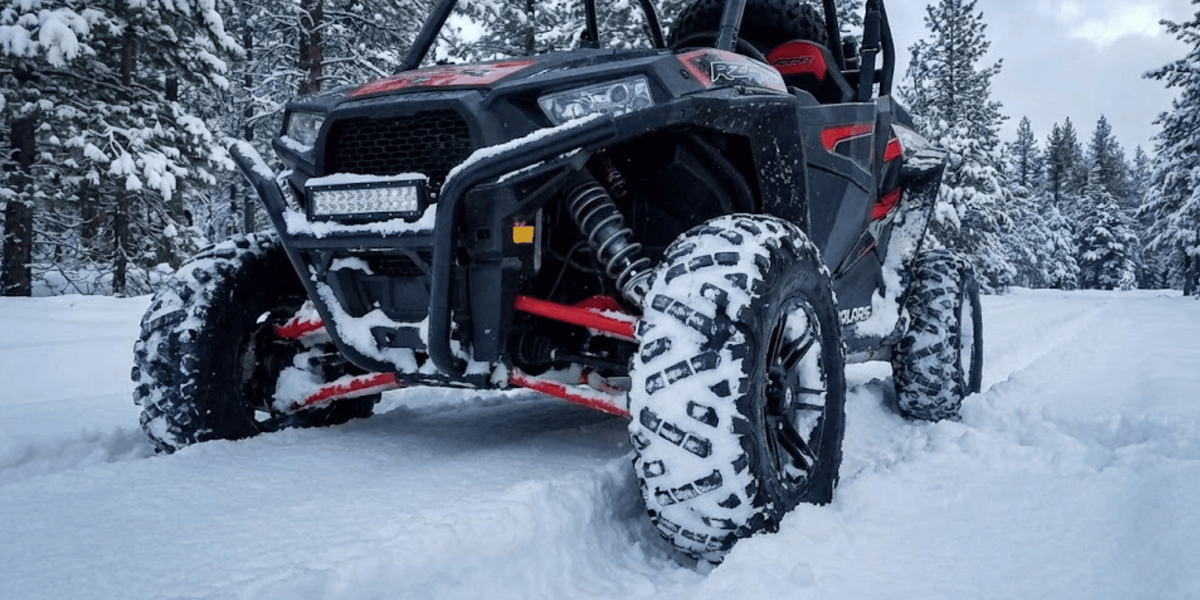
When you start shopping for the best UTV snow winter tires, you quickly realize your stock all-season UTV tires aren’t going to cut it once temps plunge below freezing. Most riders park their machines when the flakes fly, but for the serious enthusiast or the utility worker, winter is just another terrain type to conquer.
However, the "all-terrain" tires that came stock on your machine often turn into hard plastic hockey pucks when the thermometer drops. While summer compounds lose their grip in freezing temperatures, purpose-built snow tires maintain the flexibility and traction needed for everything from plowing snow to remote ice fishing expeditions.
The best UTV snow tires combine specialized rubber compounds, aggressive tread patterns, and construction techniques that excel in cold weather conditions. Whether you’re navigating frozen desert landscapes, handling utility work in deep snow, or exploring winter trails, choosing the right tire setup is crucial for both performance and safety.
This is your definitive guide to winter rubber. We’ll break down the physics of cold-weather grip, compare the top contenders, and help you decide if you need studs, chains, or just a better set of tires.
The short answer
All 6 we compared, ranked
Kenda Bearclaw HTR
Radial · 8-ply · 25–28 in
- Tread edges act like sipes on ice
- Tall, wide-spaced lugs self-clean
- Compound stays soft in the cold
- 8-ply carcass shrugs off hidden rocks
- No 32 in+ sizes
- Not for big turbo rigs
Maxxis Bighorn 2.0
Radial · 6-ply · 25–30 in
- Floats on powder at 5 PSI
- Staggered lugs paddle without digging
- Light casing
- 6-ply sidewalls tear on hidden rocks
- Not a purpose-built winter tire
System 3 XTR370
Radial · 8-ply · 28–32 in · tread depth 0.75–1.0 in
- Flat, deep blocks take screw-in studs
- Studded, it rivals a snowmobile on lake ice
- Solid all-terrain without studs
- Needs studs to shine
- Studs ruin it for summer
- Heavy at 35–45 lb
ITP Blackwater Evolution
Radial · 8-ply · 25–34 in
- Non-directional: same bite in reverse
- Handles plow and salt-spreader weight
- Tough as nails
- Harder compound slips on sheer ice
- Heavy at 28–40 lb
ITP Mud Lite XL / XXL
Bias · 6-ply · 25–30 in · lugs 1.125–1.3 in
- Shovel-sized lugs dig through slush
- Stiff bias carcass cuts crusted snow
- Lighter than radials
- Rough ride on hardpack
- Lugs thump on frozen trails
Tusk Mud Force
Bias · 6-ply · 25–26 in
- Chevron lugs clear slush and wet snow
- Cheapest here that we would run
- Light
- Vibration on hardpack
- Less ice grip than the Bearclaw
- Only 25–26 in sizes
Best UTV Snow Tires 2026 – Quick Picks
If you're freezing in the garage and just need to know what to buy, here is the cheat sheet.
- Best Overall Winter Tire – Kenda Bearclaw HTR
- Why: The go-to for 90% of winter riders (trail & light utility). Massive grip, excellent self-cleaning, and 8-ply durability at a solid price.
- Best for Deep Powder – Maxxis Bighorn 2.0
- Why: Lightweight casing and balloon-like lugs help it float over powder instead of digging a hole.
- Best for Ice & Hardpack – System 3 XTR370 (Studded)
- Why: Add screw-in studs and it becomes a weapon on lake ice and plowed hardpack roads.
- Best Heavy Duty / Work – ITP Blackwater Evolution
- Why: Non-directional radial that handles the weight of plows, salt spreaders, and repeated back-and-forth shifting without wear.
- Best Budget Winter Tire – Tusk Mud Force
- Why: Aggressive, mud-style tread that works well in slush and wet snow for a very low cost.
The Science of Winter Grip (Why Summer Tires Fail)
To pick the right tire, you have to understand why your stock tires fail in January. It isn't just about tread depth; it comes down to three factors: Compound, Tread Design, and Siping.
1. The Glass Transition Temperature (Compound)
Rubber isn't just rubber. It is a complex chemical mixture designed to operate within a specific temperature range.
- Summer/Hardpack Tires: These use a harder compound designed to resist chunking on sharp rocks at 90°F. When the temp drops below 45°F, this rubber begins to harden. At 10°F, it acts like hard plastic, sliding over obstacles instead of conforming to them. This is why you can slide sideways on a flat trail in winter even with "knobby" tires.
- Winter Compounds: These use higher silica content or softer natural rubber blends that remain pliable in sub-zero temps. This flexibility allows the tire to "wrap" around ice irregularities and frozen rocks, finding mechanical keying (grip) where a hard tire would slip. The softer the rubber, the more it can grab onto the microscopic texture of frozen ground.
2. Tread Design: Void Ratio for Snow
- Self-Cleaning: Snow is sticky. It likes to pack into the gaps between your tire lugs. If your tire tread packs full of snow, you are essentially trying to drive on a "snow slick" (snow-on-snow friction is terrible). You need a high void ratio—large gaps between lugs—to eject snow with every rotation.
- Paddle Effect: In deep snow, you need lugs that act like paddles, scooping the loose powder to propel the machine forward. This is why mud tires often double as excellent deep-snow tires. The mechanics of displacing soft mud and soft powder are remarkably similar.
3. Siping: The Ice Biter
Look closely at a winter car tire on your truck. You will see thousands of tiny zigzag slits cut into the tread blocks. These are called sipes.
- How they work: As the tire contacts the ice, these slits open up, creating thousands of tiny biting edges that grab the micro-texture of the ice. They also give water a place to escape, preventing the tire from hydroplaning on the thin layer of water that forms on top of ice.
- UTV Application: Very few UTV tires come factory-siped (the Kenda Bearclaw HTR is a rare exception). However, you can add sipes to any tire with a heated grooving tool if you are serious about ice performance.
Rider Archetypes (Which Winter Warrior Are You?)
Winter riding isn't monolithic. A guy plowing a driveway in Minnesota needs different rubber than a guy blasting powder trails in Utah. Find your archetype below to see the specific setup we recommend.
Archetype 1: The Plow King (Utility / Work)
- Mission: You wake up at 4 AM to plow the driveway. You haul firewood. Traction on hard-packed ice and concrete is your priority. You spend a lot of time shifting from Drive to Reverse.
- The Problem: Pushing a heavy blade creates massive resistance. You need forward bite on slippery surfaces. Wide tires act like snowshoes here—they float on top of the slush you want to scrape away.
- The Solution: You need a narrower tire (to cut through slush to the pavement) with sharp edges or studs. Chains are often a better investment than new tires here if you are keeping speeds low.
- Your Tire: ITP Blackwater Evolution (Tough, non-directional radial) + Chains.
Archetype 2: The Powder Hound (Recreational Trail)
- Mission: You are the first one on the unplowed forest service roads. The snow is 12-18 inches deep and fresh. You want to explore, not work.
- The Problem: If you sink, you are high-centered. Once the frame hits the snow, your wheels just spin freely. You need flotation above all else.
- The Solution: You want a wide, balloon-like tire with massive paddles. Airing down for deep powder (4-6 PSI) flattens the footprint and helps you stay on top of the crust.
- Your Tire: Maxxis Bighorn 2.0 or ITP Mud Lite XL.
Archetype 3: The Ice Fisherman (Lake Runner)
- Mission: Dragging a shanty 3 miles onto a frozen lake.
- The Problem: The lake is a sheet of glass, possibly covered by wind-blown drifts. One spin-out means you are stuck or spinning helplessly.
- The Solution: You need studs. Rubber alone cannot grip smooth glare ice reliably. A studded tire is mandatory for safety to stop and turn.
- Your Tire: System 3 XTR370 (Studded).
Archetype 4: The Mixed-Season Rider
- Mission: You ride year-round. You encounter mud, frozen dirt, some snow patches, and rocks. You don't want to swap tires every season.
- The Problem: You need a tire that isn't so soft it wears out in summer, but isn't so hard it slips in winter.
- The Solution: A high-quality All-Terrain tire with good self-cleaning properties and natural siping in the tread blocks.
- Your Tire: Kenda Bearclaw HTR.
The Contenders (Deep-Dive Reviews)
We’ve tested these in the slush, ice, and powder. Here is the breakdown of the best winter rubber for 2026.
1. Kenda Bearclaw HTR
The King of Winter Versatility
- Type: Radial, 8-Ply
- Best For: 90% of winter riding (Trail, Light Plowing, Mixed).
- Sizes: 25–28 inch.
- Approx. Weight: 25–32 lbs.
Why It Wins: The Kenda Bearclaw HTR (Hard Terrain Radial) stands out as one of the most trusted options for winter UTV performance. Unlike most UTV tires that rely solely on big lugs, the Bearclaw features a tread pattern with distinct edges and center knobs that act like sipes.
- Deep Lugs: The lugs are tall and widely spaced, making them exceptionally effective in powder and deep snow conditions. They clean out wet, heavy snow instantly.
- Rubber Compound: The compound stays surprisingly soft in the cold, allowing the tire to flex and grip on frozen roots and rocks where other tires would slide.
- Durability: It is an 8-ply radial, meaning it is tough enough to handle hidden jagged rocks under the snow without puncturing.
The Trade-off: It is not available in massive sizes (32"+), so it is better suited for mid-sized UTVs or utility machines rather than big-horsepower turbo rigs.
2. Maxxis Bighorn 2.0
The Powder Flotation Master
- Type: Radial, 6-Ply
- Best For: Deep Powder, Dunes-to-Snow.
- Sizes: 25–30 inch.
- Approx. Weight: 22–28 lbs.
Why It Wins: While not marketed specifically as a winter tire, the Maxxis Bighorn 2.0 is legendary in the snow community. Why? Because it is light and balloon-like.
- Flotation: The large air volume and flexible 6-ply carcass allow it to flatten out tremendously at low pressure (5 PSI). This keeps the machine on top of the snow rather than digging a hole.
- Tread Design: The non-directional, staggered lugs act like mini-paddles. They scoop snow efficiently without digging too deep.
The Trade-off: It is a 6-ply tire with softer sidewalls. If you hit a sharp hidden rock under the snow, it is more prone to sidewall tears than an 8-ply option. Carry a trail-rated tire repair kit if you run these in rocky areas.
3. ITP Mud Lite XL / XXL
The Aggressive Deep-Snow Option
- Type: Bias Ply, 6-Ply
- Best For: Wet, heavy snow (Sierra Cement) and slush.
- Sizes: 25–30 inch.
- Approx. Weight: Varies by size (lighter than radials).
Why It Wins: Snow acts a lot like mud. It packs, it slips, and it requires excavation. The ITP Mud Lite series takes mud technology and applies it to snow.
- The Lugs: Massive 1.125" to 1.3" lugs act like shovels. In wet, heavy snow where other tires pack up and become slicks, the Mud Lite keeps digging until it finds traction.
- Bias Ply: The bias construction is stiff, which can be an advantage when you need to cut through a crusty top layer of snow to get to the traction underneath.
The Trade-off: Rough ride on hard-packed frozen trails. You will feel the lugs thumping until you hit soft snow.
4. ITP Blackwater Evolution
The Heavy-Duty Workhorse
- Type: Radial, 8-Ply
- Best For: Plowing, Heavy Loads, Mixed Ice/Rock.
- Sizes: 25–34 inch.
- Approx. Weight: 28–40 lbs.
Why It Wins: If you use your UTV for work—hauling feed, plowing lots, pulling ice houses—you need a tire that doesn't squirm. The Blackwater Evolution is a unique non-directional radial that is tough as nails.
- Omni-Directional Grip: The tread pattern works equally well in forward and reverse—critical for the back-and-forth motion of plowing.
- Load Rating: It handles the extra weight of a plow or a bed full of salt without wallowing. It is one of the toughest tires on the market.
The Trade-off: The rubber compound is harder/tougher, which is great for durability but slightly less grippy on sheer ice than a softer tire.
5. System 3 XTR370
The Studdable Performer
- Type: Radial, 8-Ply
- Best For: Ice Fishing, Icy Trails.
- Sizes: 28–32 inch.
- Approx. Weight: 35–45 lbs.
Why It Wins: This tire has massive, deep tread blocks with flat surfaces that are perfect for accepting screw-in ice studs.
- The Strategy: Without studs, it's a solid all-terrain tire. But its true winter potential unlocks when you stud it. The tread depth (0.75-1.0 inch) is deep enough to hold studs securely without puncturing the carcass.
- Performance: Once studded, this tire offers traction on frozen lakes that rivals a snowmobile. It turns into a dedicated winter weapon.
6. Tusk Mud Force
The Budget Winter Brawler
- Type: Bias Ply, 6-Ply
- Best For: Occasional winter riders, budget builds.
- Sizes: 25–26 inch (Limited range).
- Approx. Price: Budget-Tier (Significantly cheaper than premium brands).
- Approx. Weight: Light.
Why It Wins: The Tusk Mud Force is a classic "chevron" style tractor tread. The deep, angled lugs clear slush and wet, heavy snow better than most cheap "all terrain" UTV tires. The price point makes it ideal for machines that only see a few winter rides a year.
The Trade-off: It uses a bias-ply carcass and a cheaper rubber compound. This means more vibration on hardpack and less ice grip than something like the Bearclaw. Think "good enough to get around," not ice-racing hero.
Traction Add-Ons (Chains & Studs)
Sometimes, rubber isn't enough. When you are facing a sheet of ice or 2 feet of drift, you need metal.
1. Tire Chains: The Nuclear Option
Tire chains remain the most effective solution for extreme ice conditions and deep snow.
- Pros: Unbeatable traction. Chains bite into ice that rubber would slide over. They turn your UTV into a tank.
- Cons:
- Clearance: You must verify you have clearance between the tire and the shock/fender. You may need wheel spacers.
- Speed: You cannot drive fast. Chains are for low-speed work (under 15-20 MPH). If a chain breaks at 40 MPH, it will destroy your fender, brake line, and CV boot.
- Ride: It feels like driving on a cobblestone road.
- Best For: Plowing steep driveways, recovering stuck vehicles, extreme ice.
2. Screw-In Studs (Grip Studs / Kold Kutter)
These are hardened steel screws with wide threads and carbide tips that you screw directly into your tire lugs.
- Pros: Excellent ice traction without the clearance issues or speed limits of chains. You can ride trails at 40 MPH with studs.
- Cons: They ruin the tire for summer use (unless you remove them, which leaves holes). They can pull out if you spin the tires on rock or pavement.
- Best For: Ice fishing, trail riding in icy regions (New England, Midwest).
- Safety Note: Only run studded tires on confirmed safe ice or snow-packed trails. Driving studded tires on dry pavement or garage floors will damage the surface and dull the studs.
Pro Tip: If you stud your tires, use a dedicated set of winter tires. Do not stud your summer rock crawling tires.
3. Snow Socks
These are fabric covers that slip over the tire.
- Verdict: Generally not recommended for off-road UTV use. They tear easily on rocks and roots hidden under the snow. Stick to chains or studs.
Winter Tire Specs (Width & Pressure)
The relationship between tire width, pressure, and winter performance is counter-intuitive.
1. The "Pizza Cutter" Theory (Narrow Tires)
- Best For: Ice and Hardpack.
- Why: A narrower tire concentrates the vehicle's weight onto a smaller contact patch. This higher ground pressure forces the tread (or studs) to penetrate the ice/snow crust and find traction below.
- Setup: If you are plowing or ice fishing, stay with stock widths (9-10 inches wide) rather than going to massive 12-inch wide flotation tires.
2. The "Snowshoe" Theory (Wide Tires)
- Best For: Deep Powder / Sugar Snow.
- Why: A wide tire distributes weight, allowing you to float on top. If you break the crust in 3 feet of powder, you are high-centered and stuck.
- Setup: Wide tires (11-12 inches) run at very low pressure.
3. Tire Pressure: How Low Can You Go?
Winter conditions often benefit from extreme pressure adjustments. If you haven’t dialed in your winter PSI yet, here's what we recommend:
- Deep Powder: 4-6 PSI. You need the tire to flatten out completely to act like a track. Warning: You risk de-beading if you don't have beadlock wheels.
- Plowing/Work: 10-12 PSI. You need sidewall stability to handle the weight of the plow.
- Trail/Ice: 8-10 PSI. A balance of footprint and rim protection.
Note: Cold air drops tire pressure. If you fill to 10 PSI in a heated garage (60°F), your tires might drop to 7 PSI when you pull out into -10°F air. Always check pressure outside.
Winter Riding & Handling
Winter riding requires a shift in driving style. Even with the best tires, physics still apply.
Momentum is King
In deep snow, momentum is your best friend. If you stop, you sink. Keep a steady throttle. Avoid sudden, jerky movements. When approaching a deep drift, accelerate smoothly before you hit it, not while you are in it.
The "AWD" Factor
Always run in 4WD (AWD) in snow. Rear-wheel drive will just dig two holes and bury the rear end. However, be aware that 4WD can cause "push" (understeer) in corners on ice. You turn the wheel, but the machine keeps going straight.
- The Fix: Tap the brakes to transfer weight to the front tires, helping them bite, then get back on the gas to pull through the turn.
Braking Distance
Snow tires improve braking, but they don't perform miracles. On ice, your stopping distance can be 10x longer than on dirt. Plan your stops early. Avoid locking the brakes; a rolling tire can steer, a locked tire cannot.
Winter Tire Maintenance & Storage
Winter is harsh. Salt, freeze-thaw cycles, and ozone destroy rubber.
1. Salt & Corrosion
If you trailer your UTV on salted roads, or use it to plow salted driveways, wash it immediately. Salt corrosion will cause aluminum rims to leak at the bead, leading to flat tires the next morning. Use a rubber-safe cleaner and rinse the bead area thoroughly.
2. Summer Storage
If you have a dedicated set of winter tires, store them off the ground in the summer.
- Clean: Wash off all mud and salt.
- Cover: Keep them out of the sun (UV destroys winter compounds).
- Bag: If possible, put them in opaque tire bags to prevent ozone checking.
- Read our full guide on Best Way to Store UTV Tires for the complete protocol.
Conclusion: The Final Verdict for Winter 2026
Winter riding transforms your UTV into a snow-conquering machine, but only if the rubber meets the road (or ice) correctly.
- For the Generalist: Buy the Kenda Bearclaw HTR. It is the best all-around winter performer that won't break the bank.
- For the Worker: Keep your stock tires (or buy ITP Blackwaters) and invest in a high-quality set of tire chains.
- For the Deep Snow Explorer: Buy Maxxis Bighorn 2.0s, run them at 5 PSI, and float over everything.
The investment in proper winter tires pays dividends in safety, performance, and confidence. Whether you’re clearing snow from your driveway at 5 AM or accessing a remote hunting cabin, the right tire choice ensures you get there and back.
Stay warm, check your pressure, and enjoy the snow.
