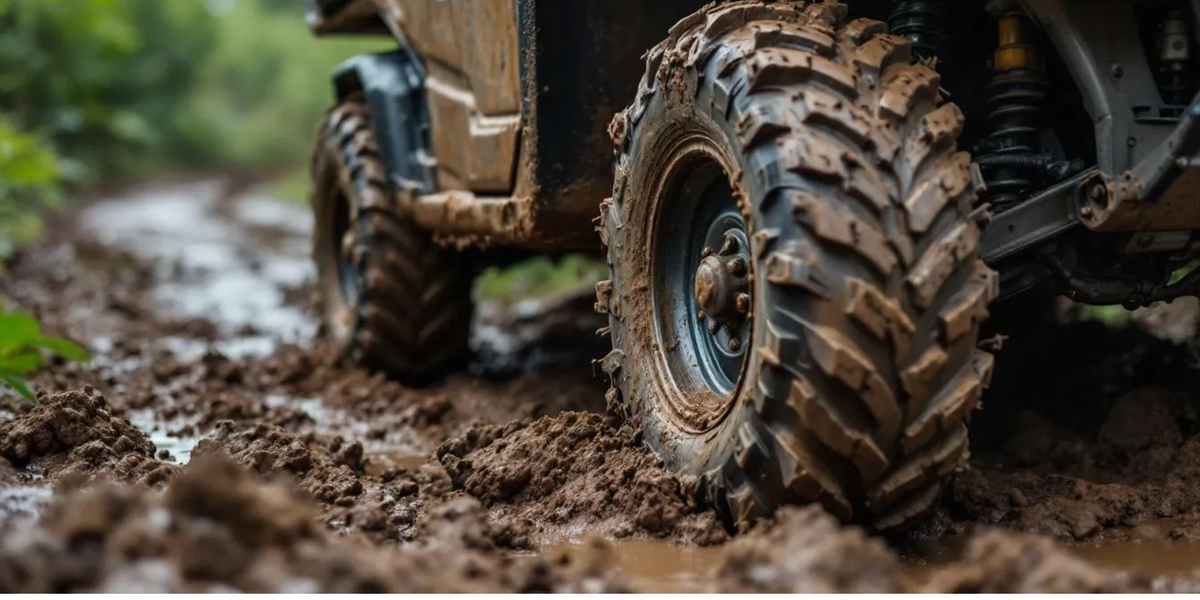
The short answer is: Yes. In fact, if you aren't airing down, you’re doing it wrong.
Driving a UTV at street pressure on soft terrain is like trying to run up a snowy hill in bowling shoes. You’re going to slip, you’re going to slide, and you’re probably going to look ridiculous doing it. But beyond the embarrassment, you are leaving massive amounts of performance on the table.
Airing down isn't just a suggestion found in the back of a manual; it’s the single most effective performance upgrade you can make to your machine, and it costs exactly zero dollars. Dropping your tire pressure dramatically transforms your off-road performance in sand, mud, and snow by increasing the tire's footprint and providing better grip.
However, there is a fine line between "maximum traction" and "walking five miles back to the trailhead because your tire popped off the rim." Getting the pressure wrong can damage your tires or leave you stranded miles from help.
Here is your comprehensive, no-nonsense guide to getting it right without destroying your wheels.
The "Too Long; Didn't Read" Cheat Sheet
If you are currently sitting on the trail reading this on your phone, waiting for your buddy to winch you out, here are the numbers you need right now:
- Sand Dunes: 8–12 PSI (Maximum flotation to stay on top).
- Mud: 10–15 PSI (Grip without losing structural integrity).
- Snow (Powder): 6–10 PSI (Float like a snowshoe).
- Snow (Packed): 12–15 PSI (Edge bite for steering).
- The "Danger Zone": Below 6 PSI on standard wheels (Do not do this).
- The Golden Rule: Always reinflate to 12–15 PSI minimum before hitting paved roads or returning to the trailer.
Why Air Down? (The Physics of Grip)

Your UTV isn't just a shrunken pickup truck. It has unique design advantages—like a lower center of gravity and independent suspension—that make airing down particularly beneficial. But all that engineering is useless if your tires are hard as rocks.
When you lower the air pressure, two magical things happen:
1. The Contact Patch Explodes
The most obvious benefit is the tire's footprint. As pressure drops, the tire squishes out, putting significantly more rubber on the ground. This distributes the vehicle's weight over a larger area, allowing you to float over soft surfaces rather than cutting into them like a pizza cutter.
Think of it this way: A UTV at 15 PSI might struggle and dig holes in soft sand, while the exact same vehicle at 10 PSI will effortlessly float on top and maintain speed. It's the difference between walking on snow in boots versus snowshoes.
2. Your Tires Become "Suspension"
UTV tires have relatively stiff sidewalls compared to passenger cars. At street pressure, they transmit every rock, root, and ripple directly into the chassis. When you air down, the tire becomes compliant. It conforms to the terrain rather than bouncing off it.
This allows your independent suspension to work better because the tire absorbs the high-frequency chatter that shocks can't catch. The result is ride comfort that feels like you just upgraded your shocks, plus less wear and tear on your vehicle's ball joints and bushings.
Tire Construction: Radial vs. Bias Ply
Before you start twisting valve caps, you need to know what kind of rubber you are running. Your tire construction—specifically whether you have radial tires or bias ply tires—plays a huge role in how you should air down. The internal architecture of the tire dictates how it flexes and, more importantly, how much abuse it can take while flexed.
Radial Tires
Radial tires are constructed with cords that run 90 degrees to the direction of travel, usually with steel or fabric belts running under the tread.
- The Air Down Strategy: Radials have flexible sidewalls by design. They bulge nicely at moderate pressure drops (e.g., going from 20 to 12 PSI) and provide excellent traction and ride quality.
- The Risk: Because the sidewalls are softer, they are more exposed to "pinch flats." This happens when you hit a rock hard enough to compress the tire completely, pinching the sidewall between the rock and your rim. If you run radials in rocky terrain, keep the pressure slightly higher (14+ PSI).
Bias Ply Tires
These are the tough guys of the tire world. They use multiple layers of rubber-coated fabric running diagonally (on a "bias") from bead to bead.
- The Air Down Strategy: Bias ply tires have incredibly stiff sidewalls. This is great for sidewall protection, but it means they don't bulge easily. You often have to air them down lower than radials to get the same footprint increase. A bias ply tire at 12 PSI might still look fully inflated, whereas a radial would look clearly squished.
- The Trade-off: They don't handle heat as well as radials at high speeds, and they can develop "flat spots" if parked overnight.
Terrain-Specific Pressure Guide

One pressure does not fit all. Each surface requires a different approach to how your tire interacts with the ground.
1. Sand Dunes and Beaches (8–12 PSI)
Sand is all about flotation. The goal is to maximize the surface area so you stay on top of the grains rather than churning through them.
- The Strategy: Drop to 8–12 PSI. This creates a "paddle" effect, spreading weight across a wider contact patch.
- Why It Works: This prevents the digging action that gets vehicles stuck in loose sand. The 8-12 PSI range is the sweet spot between flotation and control.
- The Risk: Heat. Sand driving usually involves high speeds and wheel spin. This generates heat in the tire carcass. If you go too low (increasing flex) and drive too fast, you risk overheating the rubber.
- Pro Tip: Sand dunes often have ripples. Aired-down tires absorb that constant jarring, making the ride significantly less exhausting.
2. Mud and Swamp (10–15 PSI)
Mud is a different beast entirely. Unlike sand, where you always want to float, in mud, you sometimes want to dig.
The Strategy: Stick to a slightly higher range of 10–15 PSI. You need the tire to be soft enough to clean itself out (the flexing helps eject the muck from the tread blocks), but firm enough to maintain structural integrity.
The Nuance: Thicker mud creates a massive suction effect. If your pressure is too low, the mud can actually grab the tire and twist it, potentially pulling the bead off the rim.
Tread Management: If you are running aggressive mud tires, keeping them slightly firmer (12-15 PSI) helps the deep lugs stay rigid so they can dig in and find grip. If you are on all-terrains, go lower (10-12 PSI) to maximize surface contact.
3. Snow and Ice (6–15 PSI)
Snow has a split personality, and you have to read the trail to survive.
- Deep Powder: Treat it exactly like sand. 6–10 PSI allows you to float on top. If you sink in deep powder, you are essentially creating a high-centered snow anchor.
- Packed Trails: Here, you need "edge bite." Running 12–15 PSI allows your tread blocks to penetrate the hard-packed surface so you can actually steer. Too low, and you'll slide right off the corner.
- Ice: Do not air down. Keep them at 15+ PSI. A soft tire on ice acts like a hockey puck—it slides. You need higher pressure to force the rubber (or studs/chains) into the ice for better grip.
- The Cold Factor: Remember, cold weather naturally reduces tire pressure (approx. 1 PSI for every 10°F drop). A tire set to 12 PSI in a warm garage might drop to 8 PSI once it sits in freezing temps. Factor this natural pressure loss into your strategy.
4. Rocky Terrain (12–15 PSI Minimum)
While we are talking about soft terrain, we have to mention rocks because they often hide in the mud or snow.
- The Strategy: Do not go too low on rocky terrain or rocky trails. You need enough pressure to force the tire against the bead and provide sidewall rigidity.
- The Risk: If you hit a sharp ledge at 8 PSI, you will likely pinch-flat the sidewall or dent the rim. Maintain 12–15 PSI minimum here unless you are moving at a crawl speed.
How Low Is Too Low? (The De-Bead Danger)
This is the part where you save money. The absolute floor for your tire pressure depends entirely on your wheels.
Standard (Non-Beadlock) Wheels: 6 PSI Limit
If you are running stock wheels, 6 PSI is your "do not cross" line. Below this pressure, there isn't enough air pushing the tire bead against the rim lip. If you take a hard corner, hit a rut, or slide sideways, the tire will peel off the rim. This is called "de-beading," and it usually happens in the worst possible spot—like a mud hole or a steep incline.
Beadlock Wheels: 3–4 PSI (Extreme Use)
If you have invested in beadlock wheels you have a mechanical advantage. These wheels physically clamp the tire bead to the rim using a locking ring and bolts. You can safely run these down to 3–4 PSI for extreme rock crawling or deep snow without the risk of the tire popping off. This opens up aggressive options for extreme off roading that standard wheels just can't handle.
Critical Warning: Speed Kills
Aired-down tires are for slow, technical terrain. They are not for Baja racing.
- The Limit: If you are aired down below 10 PSI, keep it under 15–20 MPH.
- The Reason: Low pressure equals heat. Driving fast on squishy tires causes excessive sidewall flex. This builds up massive heat rapidly, which can lead to tire failure or blowouts.
- Handling: At high speeds, low-pressure tires feel "wallowy" and unstable. You can lose control easily if you try to drift a corner with 8 PSI in your tires.
The Gear You Actually Need
Don't be the person using a stick or a key to let air out of the valve stem. It’s inaccurate, takes forever, and you look like an amateur. To do this safely, you need the right tools.
1. A Quality Tire Pressure Gauge
Your standard pencil stick gauge is garbage at low pressures. It uses friction to move the stick, and at low PSI, it might read "10" when you are actually at 5. You need a dedicated tire pressure gauge (preferably digital) with 0.5 PSI accuracy. When you are flirting with the de-bead limit, accuracy is everything.
2. Rapid Tire Deflators
These little brass tools thread onto your valve stem and pull the valve core out, dropping pressure in seconds rather than minutes. They are arguably the best $20 you can spend on off roading gear. Look for models with built-in pressure gauges so you can stop exactly at your target.
3. A Portable Tire Inflator / Compressor
You have to air back up. A weak compressor that takes 20 minutes to inflate one tire will leave you stranded in the dark.
- Sizing: Ensure your air compressor is rated for the volume of UTV tires (which are much larger than car tires).
- Efficiency: A quality 12V portable tire inflator is your best friend here.
- CO2 Tanks: These are excellent for emergency inflation because they are fast, but cartridges are expensive for regular adjustments. Keep them as a backup.
4. Spare Valve Cores
When you use tire deflators or mess with pressure often, valve cores can get clogged with dirt or fail. Carry a valve core tool and spares—they cost pennies and can save your ride.
Step-by-Step: The Airing Down Process
Follow this routine to ensure you don't end up with one tire at 5 PSI and another at 12 PSI.
- Check Cold Pressure: Know where you started. This gives you a baseline to spot slow leaks later.
- Deflate Evenly: Drop the front tires first. Check pressure every 2-3 PSI as you go down—it drops faster than you think.
- Match the Rear: Keep left and right tires within 1 PSI of each other. Uneven pressure creates weird handling characteristics.
- Visual Check: Look at the sidewall. If the rim is nearly touching the ground or the tire is bulging excessively at the bottom, you’ve gone too low for your vehicle weight and cargo load.
- Test Ride: Drive a few yards. If the steering feels sloppy or you see the tire rolling under the rim on turns, add a little air immediately.
Trail Recovery: What If You De-Bead?
Even with the best advice, things happen. If you pop a bead on the trail, don't panic. You can often fix it without a spare.
- Clean the Bead: You need to get the mud and rocks out of the rim lip. Use water and a rag. If dirt stays in there, it will never seal.
- Lift the Wheel: Use a jack or winch to get the weight off the tire.
- The Ratchet Strap Trick: Wrap a ratchet strap around the circumference of the tire tread. Tighten it down until the center of the tire squeezes in—this forces the sidewalls out toward the rim.
- Blast It: Hit it with your compressor. (For stubborn beads, fast inflation options like CO2 work best). As the air rushes in, the sidewalls should pop back onto the bead. (Keep your fingers clear!).
- Verify: Soap it down to check for leaks, then reinflate to trail pressure.
Reinflating: The Trip Home
The fun ends eventually, and you have to hit the road.
- Don't Wait: Airing back up before you hit the pavement is mandatory. Driving on asphalt with low pressure will chew up your sidewalls and overheat the tires in minutes.
- The Numbers: Return to 18–20 PSI for mixed dirt/gravel roads, or your manufacturer's recommended spec (usually 22-28 PSI) for highways.
- Inspect First: Before you pump them up, check the sidewalls for cuts or punctures you might have picked up on the trail. Rapid inflation on a damaged tire is dangerous.
Summary
Airing down is the secret weapon of UTV performance. It improves traction, smooths out the ride, and helps your suspension work correctly.
- Sand: 8-12 PSI (Float)
- Mud: 10-15 PSI (Grip + Integrity)
- Snow: 6-10 PSI (Powder)
- Rocks: 12+ PSI (Protection)
Use these numbers as a baseline. For a comprehensive reference pressure chart covering every terrain variable, check our dedicated guide. Just remember to air back up before you hit the regular roads. Your tires (and your rims) will thank you
