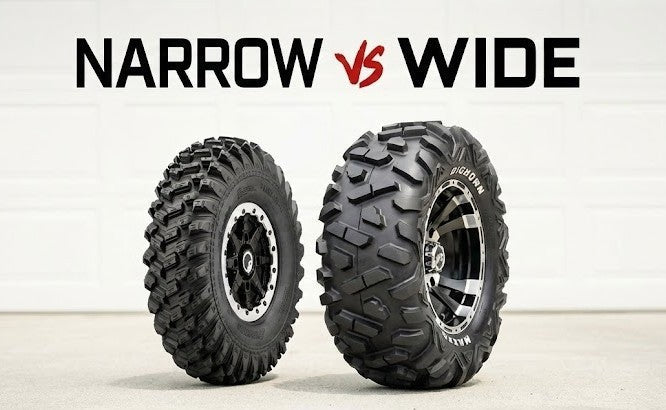

In the world of off-roading, the debate between the "Pizza Cutters" (narrow tires) and the "Steamrollers" (wide tires) is as old as the wheel itself.
Choosing between wider vs narrower UTV tires significantly impacts your vehicle’s contact patch, flotation, and steering feel across different terrain types. The difference extends far beyond appearance—affecting everything from traction and braking performance to steering effort and rollover resistance on technical trails.
Most riders assume "bigger is better" and slap the widest rubber they can fit on their machine. While a massive, wide tire looks aggressive, it isn't always the right tool for the job. A wide tire might turn your UTV into a floating hovercraft in the dunes, but on an icy trail or slick hardpack, it can feel like you are driving on hockey pucks.
Conversely, a skinny tire might look underwhelming, but it cuts through soup like a scalpel to find the traction hidden beneath. Understanding these performance characteristics helps you make informed decisions about replacement tires that match your specific riding style and terrain preferences.
Whether you’re tackling rocky terrain in Colorado, soft sand in Arizona, or muddy trails closer to home, tire width directly influences your UTV’s capability and safety. This comprehensive analysis examines the key performance differences between wide and narrow UTV tires, providing the technical data and real-world insights you need to optimize your vehicle’s performance.
Are Wider UTV Tires Better Than Narrow Ones? (Quick Answer)
- Wider UTV tires are better for sand, deep snow, and bottomless mud because they float on top of the surface and add lateral stability in corners.
- Narrower UTV tires are better for hardpack, ice, rocks, and wooded trails because they bite through loose surface layers to find traction, steer with less effort, and put significantly less stress on your drivetrain components.
At a Glance: Wide vs. Narrow Comparison
| Feature | Narrow Tires (9–10") | Wide Tires (11–13"+) |
| Best Terrain | Hardpack, Rocks, Ice, Woods | Sand, Deep Snow, Deep Mud |
| Steering Feel | Light, Precise, "Darty" | Heavy, Stable, Dampened |
| Flotation | Low (Sinks/Digs) | High (Floats/Glides) |
| Drivetrain Stress | Low (Easy on Axles/Belt) | High (Hard on Axles/Belt) |
| Ideal Rider | Trail Cruisers, Racers, Hunters | Dune Shredders, Mud Boggers |
Table of Contents
- The Physics: Contact Patch & Ground Pressure.
- Traction Mechanics: "Biting" vs. "Floating."
- Steering & Handling: The Feedback Factor.
- Flotation: Sand, Snow, and The Mud Debate.
- Drivetrain Impact: Weight, Wear, and Tear.
- The Rut Factor: Tracking and Stability.
- Rider Scenarios: Who Needs What?
- Setup Guide: Mixing Widths (Staggered vs. Square).
- FAQ: Common Width Questions.
The Physics of the Contact Patch

The contact patch represents the critical interface between your UTV tires and the ground. It is the only part of your machine actually touching the earth.
Most people think a wide tire has a larger contact patch than a narrow tire of the same height. This is a myth.
If you have a 30-inch tire at 12 PSI carrying 1,000 lbs of vehicle weight, the total contact patch area is roughly similar whether the tire is 8 inches wide or 12 inches wide. Physics dictates that Pressure = Force / Area. The air pressure supports the weight.
The Difference is Shape:
- Narrow Tires (e.g., 30x9): Create a long, narrow contact patch. This puts more tread on the ground in the direction of travel (longitudinally).
- Wide Tires (e.g., 30x12): Create a wide, short contact patch. This puts more tread on the ground laterally (side-to-side).
Ground Pressure (PSI at the Surface)
While the total area is similar, the distribution of weight changes.
- High Ground Pressure (Narrow): A narrow tire concentrates the vehicle weight into a focused strip. This forces the rubber to penetrate the surface.
- Low Ground Pressure (Wide): A wider tire spreads that weight out. This allows the tire to "float" on top of loose surfaces.
Understanding this contact patch shape is the key to unlocking why a skinny tire works in snow but fails in sand.
Traction Mechanics: "Biting" vs. "Floating"
Traction isn't just one thing. It's a mix of friction (grip) and mechanical keying (interlocking with the ground).
The Case for Narrow Tires (The "Bite")
Narrow off-road tires (often called "pizza cutters") are the kings of hard surfaces, ice, and thin mud.
- Penetration: Because of the concentrated ground pressure, a skinny tire punches through the loose top layer (slush, loose gravel, or slimy mud) to find the hard substrate underneath.
- Linear Grip: The longer contact patch puts more lugs on the ground in the direction of rotation. This improves acceleration and braking. When you slam on the brakes, a longer patch resists sliding better than a wide, short one.
- Edge Pressure: When cornering, a narrow tire digs its sidewall edge into the dirt, acting like a ski edge carving a turn.
The Case for Wide Tires (The "Grip")
Wider tires excel when the surface is impenetrable (solid rock) or bottomless (sand).
- Lateral Grip: The wide contact patch resists side-to-side movement. In high speed cornering or off-camber side-hilling, a wide tire resists rolling over or sliding sideways better than a narrow one.
- Surface Area: On slick rock (like Moab), where you cannot dig in, you rely on pure friction. A wide tire puts more rubber molecules against the rock face, especially when aired down to lower pressure.
- Paddle Effect: In loose soil, a wide tire creates a bigger "paddle" to scoop dirt, propelling the machine forward without digging a hole.
Key Takeaway: If the ground is hard underneath soft stuff, go narrow to dig. If the ground is bottomless or solid rock, go wide to float or grip.
Steering Feel and Response Characteristics
Tire width is the single biggest factor in how your steering wheel feels in your hands.
Narrow Tires: Precision and Ease
If you ride tight, twisty woods trails, narrow tires (9-10 inches) are often superior.
- Low Steering Effort: Because there is less rubber scrubbing the ground when you turn the wheel, it takes less muscle (or power steering assist) to turn. This reduces rider fatigue on long days.
- Responsiveness: A narrow tire pivots quickly. It feels "darty" and precise. You can thread the needle between trees or sharp rocks with ease.
- Turning Radius: Narrow tires allow for more steering angle before rubbing the frame or suspension arms, effectively tightening your turning circle.
Wide Tires: Stability and Dampening
Bigger tires with a wide footprint (11-12+ inches) change the personality of the machine.
- Heavy Steering: A wide patch creates significant friction when turning. You will feel this resistance in the steering wheel, especially in 4WD on high-traction surfaces.
- Stability: That resistance works in your favor at speed. Wide tires track straighter and feel less "twitchy" at 60 MPH. They act as a damper, smoothing out small steering inputs that might otherwise make the machine feel nervous.
- Feedback: Wide tires transmit more surface information. You will feel the ruts and rocks more intensely through the wheel.
Flotation: Sand, Snow, and the Mud Debate
This is where the battle lines are drawn. Flotation is the ability of the tire to stay on top of the terrain rather than sinking into it.
Sand and Dunes (Wide Wins)
In the dunes, sinking is the enemy. As soon as a tire breaks the surface tension of the sand, it digs a hole.
- The Physics: Wide tires spread the weight out, reducing ground pressure to nearly zero. This allows the UTV to glide over the sand.
- The Risk: A skinny tire acts like a knife. It cuts into the sand, forcing the engine to work harder to push a wall of sand in front of the tire. This kills momentum and belts.
Snow (It Depends)
Snow is tricky.
- Deep Powder: You need wider tires (and ultra-low pressure) for increasing flotation, similar to sand.
- Packed Trail / Ice: You want narrow tires. You need to cut through the slushy top layer to bite the frozen earth or ice below. A wide tire on packed snow acts like a snowboard—it slides uncontrollably.
The Mud Debate (Dig vs. Float)
Mud riders argue about this constantly.
- The "Bottom" Theory (Narrow): If the mud is 12 inches deep but has a hard bottom, a narrow tire slices through the slop and hooks up on the hard floor. A wide tire might float on top of the slop, spinning aimlessly without traction.
- The "Peanut Butter" Theory (Wide): If the mud is bottomless (a bounty hole or swamp), digging is death. Once you break the crust, you are high-centered. Here, a massive, wide tire (like a SuperATV Assassinator) acts like a pontoon, keeping the chassis above the suction.
Pro Tip: For most general trail riders encountering occasional mud puddles, a standard width (10") tire is the best compromise.
Drivetrain Impact: Weight, Wear, and Tear
You cannot talk about wider tires without talking about the stress they put on your machine.
Unsprung Weight and Rolling Resistance
Wider tires almost always mean heavier tires.
- Unsprung Weight: Adding weight to the corners hurts suspension performance. A heavy, wide tire creates more inertia, making the shocks work harder to control the wheel. This can make the ride feel harsh over stutter bumps.
- Rolling Resistance: A wide tire pushes more dirt, sand, or air out of the way. It takes more power to turn a 12-inch wide tire than a 9-inch one. On smaller engines (under 1000cc), switching to wide tires can noticeably sap acceleration and top speed.
Wear on Parts
- Wheel Bearings: Wide tires are often mounted on wheels with less backspacing (pushed out) to clear the suspension. This increases the leverage on your wheel bearings, causing them to wear out faster.
- Steering Rack: The increased friction of turning a wide contact patch puts massive stress on your tie rods and steering rack.
- CV Axles: Wide tires often have more grip. When you have high grip + a heavy foot + a heavy tire, the weak link is the axle shaft.
If you plan to go significantly wider than stock, you may need to upgrade your clutching or axles. If you are confused by the numbers on the sidewall, check our guide on understanding metric tire sizes for a deeper dive into the specific measurements and the "Hidden Costs" of going big.
The Rut Factor: Tracking and Stability
One of the most overlooked aspects of tire choice is how the tire interacts with existing trails.
Rut Tracking:
Most trails have two ruts worn into them by thousands of other UTVs and ATVs.
- Narrow Tires: Tend to fall into these ruts and track nicely, like a train on rails.
- Wide Tires: Often fight the ruts. If your tires are wider than the rut, they will ride up on the edges, constantly pulling the steering wheel left and right ("tramlining"). This can be exhausting on a long ride.
Uneven Surfaces:
On off-camber trails (tilted sideways), a wider tire provides a wider track width (stance). This adds a significant safety margin against rolling over. If you ride technical, tippy terrain, the stability of a wide tire setup outweighs the steering fight.
Rider Scenarios (Who Needs What?)
Let's break this down by riding style to help you choose.
Scenario A: The Rock Crawler (Moab/Johnson Valley)
- Choice: Standard to Wide (10-12").
- Why: You need puncture resistance and lateral stability on vertical walls. A wider tire offers more sidewall protection and wraps around boulders better when aired down to 8 PSI.
- Tire Pick: 32x10R14 or 35x10R15 (Square setup). Note: Modern crawlers are moving toward 10" widths rather than super-wide 12" to increase ground pressure on slick rock.
Scenario B: The Desert Racer (Baja/Vegas)
- Choice: Standard Width (10").
- Why: At high speeds, you want stability and low rolling resistance. A 10-inch wide tire tracks straight and doesn't overheat as easily as a massive flotation tire.
- Tire Pick: Tensor DS or BFG KM3 (32x10R15).
Scenario C: The Dune Shredder (Glamis)
- Choice: Wide (12-14").
- Why: Flotation is everything. You want to stay on top of the sand. Paddle tires are often extremely wide for this reason.
- Tire Pick: Sand Slingers or specialized buffed paddles.
Scenario D: The East Coast Trail Rider (Woods/Mud)
- Choice: Narrow to Standard (9-10").
- Why: You need to navigate between tight trees (50" or 64" gates). A wide tire makes the machine too wide. You also want the tire to bite through the greasy top layer of mud to find traction on roots and rocks.
- Tire Pick: ITP Mud Lite or Maxxis Carnivore (Skinny).
Setup Guide: Mixing Widths (Staggered vs. Square)
Should you run skinny tires front and fat tires rear?
The Staggered Setup (Classic):
- Front: Narrow (e.g., 29x9).
- Rear: Wide (e.g., 29x11).
- Pros: Lighter steering in front, maximum traction in rear. Looks "classic" buggy style.
- Cons: You cannot rotate tires. You need two different spares (or carry a front spare and limp if a rear blows).
The Square Setup (Modern Standard):
- All Corners: Same width (e.g., 32x10).
- Pros: You can rotate tires to extend life. One spare fits any corner perfectly. Improved handling balance (rear slides more predictably).
- Cons: Slightly less forward traction than a massive wide rear tire.
Our Recommendation: For 95% of modern UTVs, go Square (same width all around). The logistics of one spare and rotatable tires outweigh the marginal traction gains of a wide rear tire.
FAQ: Common Width Questions
Q: Will wider tires rub my fenders?
A: Likely, yes. Wider tires swing in a larger arc when turning. You may need wheel spacers, offset wheels, or forward-offset A-arms to clear them. Check your ground clearance and fender gaps before buying.
Q: Do I need wider rims for wider tires?
A: Generally, yes. Mounting a wide tire on a narrow rim causes the center tread to bulge (ballooning), reducing the contact patch and wearing the center out fast.
Q: Can I run truck tires on my UTV?
A: Yes, many riders run LT (Light Truck) tires which are typically 9.5-10.5 inches wide. They are durable and DOT approved but heavy.
Q: Does tire width affect PSI choice?
A: Yes. A wider tire has more volume and supports weight better at low pressure. You can often run slightly lower pressure in a wide tire than a narrow one without pinching the rim. Consult our UTV Tire Pressure Guide for specifics.
Q: What about "Skinny" Mud Tires?
A: There is a sub-culture of "Pizza Cutter" mud riders who run 35x8 tires. These are like saw blades—they cut straight to the bottom of the hole. They are incredibly effective in specific types of clay/bottomed mud but terrible in sand or bottomless swamps.
Conclusion: The Final Verdict
The choice between wider vs narrower UTV tires isn't about which is "better"—it's about matching the physics of the tire to the physics of your terrain.
- If you ride mostly woods/hardpack: Buy 9–10" wide tires in a square setup. You want the steering precision and "bite" to cut through loose topsoil.
- If you ride mostly dunes: Buy 11–13" wide paddles in the rear and matching (or slightly narrower) smooth buffs in the front. Flotation is survival.
- If you ride mostly rocky mountain trails: Buy 10" wide tires in a square setup. Focus on rubber compound (sticky) and ply rating more than max width.
Don't just buy the widest tire that fits because it looks cool. A properly sized tire will make your steering feel lighter, your suspension work better, and your machine climb things you thought were impossible.
